John Locke, Second Treatise on Government, Part II
- Stephan Sturm
- Dec 13, 2024
- 13 min read


In the first part, we saw that there are three reasons why people establish a state.
The first motive is that people like to be in company at all. And in principle, this is also supported by God, because God had said that it is not good for man to be alone. The second motive is that people in the natural state tend to want to do violence to other people and seek their lives.
This is not allowed, and all people must punish such offenders. This leads to different opinions about what is allowed. That is why it is better if people live together in a group and determine what is allowed and what is not. If people disagree, it is better to form a society. Then there are permanently appointed judges who can decide all disputes.
Locke says that people want to protect their property. In the state of nature, they can only protect their property to a limited extent. That is why they found a state that protects property.
A state must therefore be founded on this basis and for this purpose it must be defined what the purpose of this state is, this purpose naturally follows from the reasons and motives that people have for founding this state.
Purpose of the society

From this it is basically already clear what the purpose of society is. Because in the state of nature, property is not secure. Therefore, the most important purpose of society is to secure this property. The second problem is that in the state of nature there is no general standard for right and wrong.
Natural law actually applies. Everyone can understand that. But it is not clear how this natural law should be interpreted. That is why a society needs clear laws and judges to interpret these laws. In the state of nature, there is no power that can enforce the laws. In the state of nature, everyone must enforce natural law. But not everyone has a police force or an army to enforce it. It's better to set up a society that then enforces the laws.
The answer is obvious. Although he has such a right in the state of nature, the enjoyment of this right is very uncertain and constantly exposed to the interference of others. For as every man is king as he is, and every man is equal to him, and the greatest part do not strictly observe law and justice, the enjoyment of the property they possess in this state is very uncertain and insecure. The great and most important object of men uniting themselves into a state, and subjecting themselves to a government, is therefore the preservation of their property.
The state of nature lacks many things for this purpose. First, it lacks a fixed, permanent, known, universally accepted and recognized law that is the norm of right and wrong and the general standard for deciding all disputes between them. Second, the state of nature lacks a recognized and impartial judge who is empowered to decide all disputes according to the applicable law. Third, the state of nature often lacks the power to support the judgment, if it is just, to uphold it and ensure its proper execution.

These are the three difficulties in the state of nature. Society can solve them. The problem is that in the state of nature there is no one who can enforce the law of nature. The second problem is that there could be different opinions. The third problem is that there is of course vigilante justice, which is always a problem in society anyway. That's why people found a state. They then refrain from interpreting and enforcing the law themselves.
They hand over this authority to the state. This has the advantage for them that they do not have to act themselves and now have an impartial judge. In a state of nature, everyone can act for themselves.
They do this to protect themselves and their property. The force of society may only be used to protect freedom and property. These are the most important rules that determine what the state may and may not do.
For in the state of nature, apart from the freedom of innocent pleasure, man has two powers. He gives up the first power, namely, to do what he thinks proper for the preservation of himself and the rest of mankind, that it may be regulated by the laws of society, so far as the preservation of himself and the other members of that society requires.
The second power, namely the power to punish, he gives up completely and leaves it to the assistance of the executive of this society, as required by its law.

When you join the state, you have to give up some rights. Above all, you are no longer allowed to do whatever you want. Vigilante justice is not allowed in a state.
To do this, we must first clarify what the state is actually supposed to do. Locke says: The state must govern according to fixed laws. Resolutions, administrative regulations or similar are not permitted.
It must appoint impartial judges to decide disputes. They must not favor any particular people. It must ensure security, because only then is the property safe.
If it achieves this, there will be peace, security and prosperity for all. The most important task in Locke's state is to make laws. Locke's state only works if it abides by the law and does not make decisions on a whim. So there has to be someone who makes the laws.
Legislative power
The part about taxes for Locke's time is particularly important. The king always wanted more taxes, which Parliament refused to pay. Locke says that this is not allowed. The state is not allowed to do everything it wants.

For example, it may not encroach on citizens' property.
In these cases, the government or parliament can always be changed immediately. The legislature is the highest and most important power. The legislature must approve all regulations. Locke wants a state with fixed laws. But the legislature does not have absolute power either. It is always limited by the social contract and natural law. Locke says that there can be no absolute power. It has no power over the lives and fortunes of men.
Locke says that no one has the right to his own life because God determines it. So he cannot give this right to anyone. He needs his wealth to live. That's why no one is allowed to have any of it.
A government is not allowed to determine the lives and property of its citizens. Of course you can't give this power to anyone. If you don't have it yourself, you couldn't have it in the state of nature. Therefore, there can be no government in which the people give a ruler the right to determine life and property. These laws must always be in accordance with natural law.
They are null and void, even if they are passed by the legislature. Locke says that natural law comes from God. That is why religion is always important in the end. It follows that there can be no absolute and arbitrary power. For then people would be worse off than in the state of nature. In other words, everything that is laid down in the social contract also determines the limits of state power.
Everything the state does must be in the social contract. Everything that violates the social contract is illegal.
And of course the state cannot take property away from citizens because the protection of property was the reason for the foundation of the state. That was the central motive. And if the citizens were to allow the state to take away their property, they would be worse off than before the social contract and worse off than in the state of nature. And it cannot be assumed that they had this intention.
This legislative power is not only the supreme power of the state, but it is sacred and unchangeable in the hands into which the community has once placed it. The rules they lay down for the actions of other people must, like their own actions and those of other people, conform to natural law, i.e. the will of God. And since the fundamental law of nature is the preservation of mankind, no human law can be good or valid that contradicts it. Third, take away part of his property. Thirdly, the supreme power cannot take away any part of a man's property without his consent. For since the preservation of property is the purpose of government and the reason for which men enter into society, it necessarily presupposes and requires that they have property.
This is therefore the most important function in Locke's state. The legislature is the most important body in the state. But there must also be a government. Because the legislature does not always meet, there must be a permanent representative body that can enforce the laws at any time.
And Locke has another special function, the Federal, which is responsible for disputes with foreign people and, above all, for concluding alliances with foreign states and negotiating war and peace.
Legislative, executive and federal

Of course, we are primarily interested in the relationship between the legislative and executive branches. In a democracy, the legislative and executive powers are separated from each other. The government is not allowed to make laws and parliament does not execute laws.
So there is a balance of power and no one has too much power.

The executive is the executive power. It is needed to ensure that the laws are observed. While Locke's parliament did not meet every day, it met on occasion. Normally, the legislature does not have to meet if the laws do not need to be changed. If a new law is necessary, the legislature must create a legal basis.

Locke has a special form of government. As a rule, there is always a legislature, an executive and a jurisdiction. Legislature, executive and jurisdiction are the three powers of the state. In Locke's case, the function of jurisdiction is actually also assumed by the legislature. Instead of this jurisdiction, Locke then has a special power, which is responsible for foreign policy alliances, i.e. foedera. This is where the name federal power comes from. Today, this is the foreign ministry, so to speak. The federal power decides on war and peace. These questions already existed and were discussed in Locke's time. Therefore, there must be a special function for them.
It therefore includes the power of war and peace, of alliances, and of all agreements with all persons and communities outside the state, and may, if it pleases, be called the federal power. These, then, are the three powers in Locke's state, the legislative, the executive and the federal.
For the various powers to work together, there must be a hierarchy.
Subordination of powers

So this is a special feature of Locke that the government can put itself in a state of war with the people, so to speak, and then there is a right to armed rebellion.
Normally, state theorists have rejected this. Locke provided many ways of getting rid of a government. A government can be voted out of office at any time.
Then parliament dissolves the government. Replacing the government is easy. The legislature can take power away again. Today, this can be done with a vote of confidence or a vote of no confidence. Replacing the government is easy.
This is how you can hold a bad government to account. This is also something special about Locke. The government has to answer for its actions.
So Locke goes much further than most state theorists do.
We must distinguish between good and bad forms of government. We have already seen in the first part that under no circumstances can the government be interpreted as a patriarchal government. The rule of a father over his children is completely different from government in a state. That is why a paternal government is illegitimate from the outset. In addition, there are of course various other ways of defining despotic power.
Of course, they are all illegitimate and lead to the people being allowed to resist.
Despotic power
Despotic power is an absolute arbitrary power that one person has over another to take his life when he pleases. This is a power which neither nature gives, because it has made no such distinction between one man and another. Nor can a contract confer it. For since a person cannot arbitrarily dispose of his own life, he cannot grant it to another person either.
That much is clear. Nobody can have the right to a despotic government, because nobody has the right to hand over such arbitrary power over life and property to a government. A special case of despotic government could be conquest. However, Locke also severely restricts the rights of a conqueror.
Conquest
According to Locke, conquest does not establish a state, but only destroys the old one. For Locke, society is dissolved, not just the government. This means that a new social contract must be created. Because just because you win a war doesn't mean you can subjugate others and force them to obey. That is violence. Violence is no reason to force people to obey. Only a treaty can determine that citizens must obey. This means that the old state has been conquered. Society ceases to exist. The people must make a new social contract and install the conqueror as ruler.
The conqueror can kill his opponents. That is clear, because he is waging war against them. In war, you are allowed to kill your opponent. But he must not take their property. This would not only punish those who fought against the conqueror, but also their descendants. Perhaps they had nothing to do with the war.
Because they would get the inheritance. He cannot subjugate the whole people. Many did not even fight in the army. That is why you must not subjugate a people who have not resisted. Resistance is not wrong in itself. Locke says that one may resist an unjust ruler by force. The only case where rebellion is unjust is if you have concluded new treaties with the new ruler and then break them. This is, of course, a breach of contract and as such wrong. So Locke also sets very strong limits to the conqueror, and he cannot establish state rule by force alone.
This applies even less to a tyrant. This is someone who comes from within and takes over.
Tyranny

Tyranny consists in the fact that someone who has legitimate power uses this power for his own benefit and to the detriment of his subjects. In other words, someone who had a mandate to govern and then used this mandate for his own benefit. Locke says that this also applies to someone who has been permitted by the king to act against the law. For the king may not allow anyone to act against the law. Therefore, no one may accept an unlawful commission from the king. Otherwise he too would be a tyrant.
This is the case when someone uses the power he holds in his hands not for the good of those subject to it, but for his own private special advantage. When the ruler, however he may be titled, makes not the law but his will the norm and his commands and actions are directed not to the preservation of his people's property but to the satisfaction of his own ambition, revenge, lust or some other unbridled passion.
Locke knows that. Locke does not want a dictatorship. Locke has therefore laid down precise rules as to when a government may be dissolved.
Dissolution of the government

In Locke's view, therefore, there are various reasons why the government should be dissolved.
Locke assumes that there are two different contracts: the social contract and the contract of rule. That is why it is simpler for him. This means that if the government is dissolved, society remains. There is no reason to dissolve society. The government can be dissolved at any time.
When people unite to form a state, they can no longer return to the state of nature unless they are forced to do so from outside. If people dissolve the government, they do not return to the state of nature. They simply change the government. When society is dissolved, the government is dissolved too. This only happens when the country is conquered from outside.

The government can therefore be dissolved at any time without dissolving society. There are many reasons why a government can be dissolved. They all have to do with a change in the legislature.
The first case is when someone makes laws even though they are not authorized to do so. This refers to the government, i.e. the king. The king makes laws that are not legitimate. He is not authorized to do so. So the prince must be deposed. This happens when the prince simply does what he wants without abiding by the law. That is not allowed. It would abolish the legislature. Then only the prince can make laws.
That is a reason to dissolve the government. In Locke's time, it was often done by preventing the legislature from assembling. Then the legislature can no longer make laws. So the government has to be changed.
You could also change the election modalities. That's a popular trick. You only elect people you want to the legislature. That is not allowed. Parliament can change the election modalities, but not the Prince.
The penultimate case is that the prince or parliament sells the people to another state. That is not allowed. With Locke, it's interesting when the government doesn't do its job. Then the people no longer trust it. So the people can elect a new government.
The government and the prince can therefore simply be deposed. The legislature can also be deposed if it is unable to perform its duties because the king does not allow it.
If one or more persons, not appointed by the people, undertake to make laws, they make laws without permission, and the people are not bound to obey them. And thereby it becomes free from subjection, and can establish a new legislature over itself, as it thinks best.
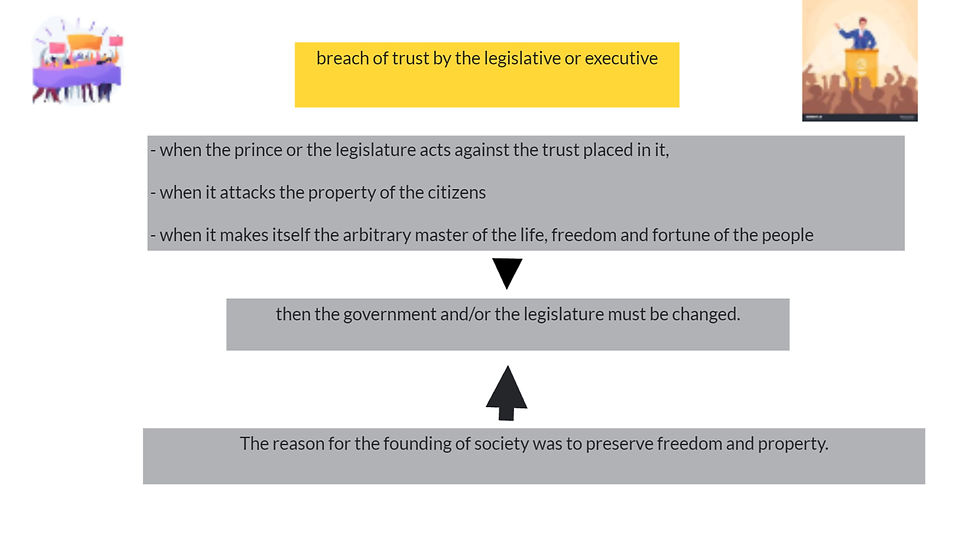
The legislature can therefore be replaced if certain circumstances exist. When it comes to a breach of trust by the legislature or the executive, this is more difficult to establish. If the prince or the legislature abuse the trust of the citizens, they can be dissolved. If the government or the legislature encroaches on the property of the citizens or makes itself master of the life, liberty and property of the people, it must be dissolved. People entered society to preserve freedom and property. If this reason no longer applies, people no longer want to have anything to do with society. That's why you can't dissolve society, you can only change the government or parliament.
So there is another way in which governments can be dissolved, namely when the legislator or the prince acts contrary to the trust placed in them. Whoever needs force without right, as it is practiced in a society by all who use it without right, puts himself in a state of war with those against whom he uses it. And in this state, all previous duties are suspended, all other rights no longer exist and every individual has the right to defend themselves and resist the attacker.
Locke therefore gives the people very far-reaching rights. There are many reasons why the government or the legislature can be dissolved. For Locke, it is not necessary to dissolve the entire society in order to dissolve the government. A government must be dissolved when the foundations of the social contract and the motives for which a society was founded are no longer respected.
People establish a society to protect their lives, liberty and property. If the state does not protect people, they do not need a state. Then they can dissolve it.
If the government or parliament uses force to remain in power, the people may also use force to defend themselves.
Locke goes very far in his theory of the state. One could also say that securing freedom, life and property is not enough to establish a state. Citizens must take care of most other problems themselves.
Locke says nothing about social justice. That is not important in his state. It is said that Locke founded a state of the rich. Only people who own something have an interest in it.
Locke would say that everyone has an interest in the existence of private property. Because everyone benefits from people owning property. As a result, they cultivate the land and there are more goods and therefore more wealth.
Locke is very liberal. He is more liberal than Kant, Hobbes or Rousseau. This is the basis for all liberal concepts of society. Whether this is sufficient for every purpose and whether it is a good basis for a modern state can be discussed elsewhere.
Video about this Content:


Comments